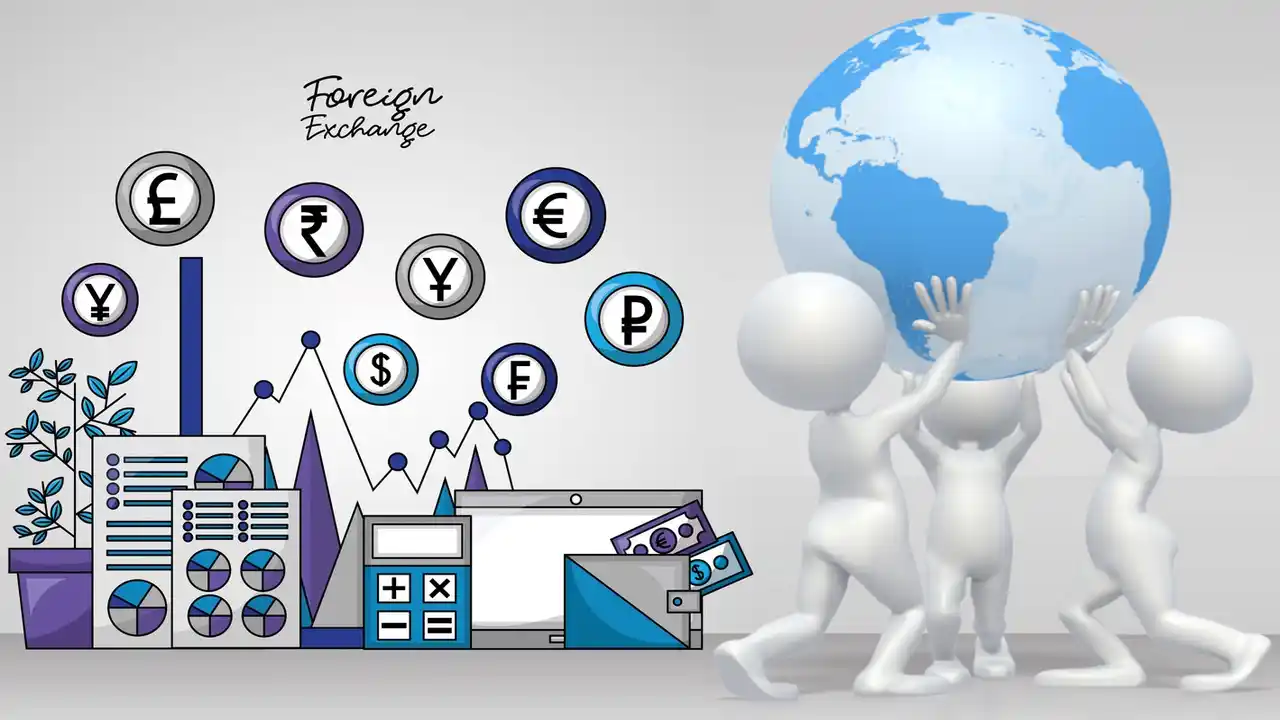
Foreign exchange trading, or Forex trading, is the buying and selling of currencies on exchanges. The lack of physical commodities and centralized markets characterizes OTC trade. In contrast to the stock and securities markets, which feature neither of them, this one does not. Another crucial industry that could affect global prices and exchange rates is currency trading. Forecasting future changes in currency rates is a common usage for forex trading among professionals in banking, fund management, and the financial management of international enterprises. We will go over the advantages of foreign exchange market in detail in this article.
The foreign exchange market (or fx market) is a place where investors can buy and sell currencies from all around the world. Foreign exchange (forex) trading is the buying and selling of contracts based on the value of various currencies. The volume of imports and exports in any one country can be significantly impacted by activity on the foreign exchange market. For tips on functions of foreign exchange market, check out this guide specially for you.
Advantages of Foreign Exchange Market
Known variously as forex, FX, and the currencies market, the foreign exchange market (FX) is an OTC market that determines global currency exchange rates. The term “forex market” can also be used to refer to this marketplace. Market participants can speculate on the future values of various currencies by buying, selling, trading, or doing any combination of the foregoing. Read on to discover everything there is to know about advantages of foreign exchange market and to become a subject matter expert on it.
Making Things Easier to Get to
Currency trading is becoming increasingly accessible as more people gain access to global currency markets. Trading on the foreign currency market can be profitable for private investors despite the fact that most forex investors are large institutions. The Foreign Exchange Market (Forex) is now accessible to retail investors via the Internet. People looking for both short-term and long-term income can trade forex with greater ease thanks to the proliferation of trading apps and online brokerages. Flexibility is an advantages of foreign exchange market, as it operates 24 hours a day, five days a week, accommodating different time zones.
Automation
Automated trading systems can be useful in the foreign exchange market. By predetermining entry, stop-loss, and limit prices, Forex traders can automate their trades. Investing automatically requires research. The Forex trading platform can also be instructed to make trades in response to changes in market conditions or specific price levels. However, they are not compelled to comply.
With a well-planned automated system, a forex trader may be able to profit from the daily fluctuations in the foreign exchange market without putting undue mental or physical pressure on themselves. One of the advantages of foreign exchange market is its high liquidity, allowing for easy buying and selling of currencies.
Possible for Quick Returns
Currency exchange markets are highly volatile and active. The fact that forex traders can typically employ more leverage raises the possibility that the forex market provides traders with faster gains than other markets. Traders in some marketplaces may need to wait for “organic” growth and returns on the assets they sell. On the foreign exchange market, this is not necessary. The low cost of opportunity lost by foreign exchange dealers is largely attributable to the rapid pace at which the currency market operates. This is a significant advantage of the currency exchange industry.
Pay Less for Transactions
One of the many advantages of trading in the forex market is the low entry barrier and low transaction costs associated with buying and selling currencies. This is yet another advantage of participating in the foreign exchange market. The transaction costs paid by investors who work with brokers are typically lower than those paid by investors who deal directly with stock exchanges. As a result, the discount between buying and selling prices is narrowing. A wider variety of people will now have access to currency exchange.
Flexibility
Traders on the forex markets have considerable leeway in their decisions. The freedom to transact with an unlimited amount of currency is the primary factor. There is also a lack of regulation in the market. This, along with the market’s around-the-clock accessibility, provides merchants with a highly adaptable working environment.
Anyone with a “normal” employment can trade the FX market on the weekends and after hours. However, they can’t maintain the same behavior whether investing in stocks, bonds, or their own countries. Since Forex trading can be done on a flexible schedule and has less of an impact on one’s primary occupation, it is a popular choice among part-time traders.
The Technical Plan
On the foreign exchange market, technical analysis can be a helpful tool. Investors in stocks and bonds may need to perform extensive research into the history and financial stability of the companies issuing the securities to which they are exposed. However, foreign currency traders can often benefit from engaging in technical analysis of price charts.
In contrast, technical analysis relies on past price data and trends to reveal how the market perceives supply and demand and how investors and other stakeholders feel about the assets under consideration. Contrarily, basic research entails conducting extensive preliminary research into the assets under consideration.
Global Trading Markets
Trading in foreign exchange occurs on a wide variety of markets around the world. The widespread distribution of FX markets provides investors with several opportunities to buy and sell currencies at a profit. Due to its global nature, the foreign exchange market is accessible throughout the clock, every day of the week (although often Monday through Friday). This means that traders can conduct currency transactions from virtually any location in the world, 24/7/365.
Transparency
The foreign currency market operates over a wide range of time zones due to its sheer size. Knowledge on the Forex markets is readily available from a variety of sources. Another difficulty is that a single nation or Central Bank cannot permanently control pricing or a large portion of the market. Since information travels slowly, it’s feasible that some communities will reap the benefits rather soon. However, it is impossible to maintain this advantage indefinitely. Because of its massive size, the foreign currency market is efficient and fair.
Costs of Transactions
The costs of conducting business on the foreign exchange market are minimal in comparison to other marketplaces. Foreign currency (Forex) trading has very cheap transaction costs compared to other markets. Dealers dominate the Foreign Exchange market, which is why prices are presented as a proportion of total costs. These brokers provide two-way quotes after pocketing a spread to protect themselves from potential loss. Trading costs for “pure plays” have dropped to a record low in the foreign currency market.
Simple Tax Rules
Tax authorities may require traders in other marketplaces to maintain detailed records of their short-term and long-term transactions for compliance purposes. It may be easier to calculate taxes for sellers in the foreign exchange market because they are subject to simpler tax regulations.
Options Trading
There is a wide variety of trading strategies available on the currency markets. There are hundreds of different currencies available for trade on the market. They can also decide to engage in futures or spot market trading with their spouse. Futures contracts are also available in a wide variety of sizes and durations to accommodate the varying requirements of currency market participants. This diversity means that traders in the Foreign Exchange market can find suitable strategies regardless of their risk tolerance.
Consideration must also be given to the enormous volume of activity on the Forex markets. The foreign exchange market has more activity than any other market in the world. Because participants can enter and exit the Foreign Exchange market at any time, traders have access to unprecedented liquidity.
Fees and Commissions will be Lower
Commissions and other hidden charges can add up quickly when trading stocks, bonds, mutual funds, or other goods. These two factors can add unexpected costs to a trade. These fees are not part of currency trading on the foreign exchange market.
The “bid-ask spread,” the difference between the “buying” and “selling” prices that brokers report in real time, is one factor that traders consider when estimating the costs associated with trading foreign exchange. People tend to be more candid when exchanging money in this way.
Easy to Sell Short
Borrowing assets and gambling that the asset’s supporter will buy the short position back is necessary in particular markets. However, shorting currencies on the foreign currency market is significantly simpler. Currencies are traded in “pairs” at all times. This means that any time a seller acquires one currency, they must also dispose of another. If investors anticipate a decline in the value of a currency, they need just sell it and purchase a connected currency. They can accomplish this without resorting to borrowing.
Less Chance that Insiders will Try to Change Prices
Insider information has a significant impact on the stock, bond, and commodity markets, but it is less influential in the decentralized foreign exchange market.
Those who work for the government or the central bank are the most likely to possess “inside information” regarding the future direction of the currency market. Typically, the public and the government keep a tight eye on those who fall into this category. This fact contributes to the view that the forex market is more liberal than other trading venues.
Accessibility
The foreign currency market is one of the more accessible markets for individual traders. Opening a Forex trading account is quick and easy, taking no more than a day, and traders need only fifty pounds to get going. Online trading is available through most brokerages, giving investors real-time access to market data like prices, news, and charts. A plethora of internet exchanges are also available. The Foreign Exchange market is accessible to traders around the clock, five days a week, making it more convenient than other markets to include into busy schedules.
Leverage
There is more leverage in the foreign exchange (FX) market than in any other market for financial assets. Due to the structure of the forex markets, traders might potentially gain a 30x return on their initial capital. Earnings and income are projected to rise as a direct result of this. Traders can make or lose a lot of money in the Forex market despite the fact that most price movements are rather minor.
Liquidity
The foreign exchange market is the world’s largest market by value. As a result, large currency pairs can be traded with relative ease in most cases. Traders at forex brokerages that employ the trading desk model are typically provided with adequate trading liquidity. The reason for this is that the exchange will typically take the opposing side of a deal when liquidity is low elsewhere in the market. One of the most compelling aspects of the foreign exchange market is its high degree of liquidity.
FAQ
Who Runs the Market for Foreign Exchange?
The Reserve Bank of India is the official custodian of India’s foreign exchange reserves and is responsible for their safekeeping. The Reserve Bank of India Act of 1934 lays out the stipulations for the administration of a country’s foreign exchange reserves.
Where is the Market for Foreign Exchange?
The foreign exchange market operates as a distributed electronic network with nodes at financial institutions worldwide. The market is not centralized in any one location. The forex market operates around the clock, every day of the week. Market activity is divided into regional hours based on major financial hubs when buyer and seller activity is highest.
Where is the Biggest Place to Buy and Sell Foreign Currency?
The finest place to purchase and sell foreign currencies is London, which also happens to be the capital of the United Kingdom. According to recent data, 37% of all global currency transactions take place in London’s foreign exchange market.
Final Words
The typical fees and levies that buyers might face in another market will not apply here. The market is open around the clock, so you may make trades whenever it suits you. This effectively eliminates any rigid trading restrictions. You have the freedom to trade whenever you like and to purchase as much currency as your account balance and leverage allow. If you’re afraid about financial loss, this holds true regardless. The advantages of foreign exchange market will be covered in-depth in this article, along with some examples for your convenience.