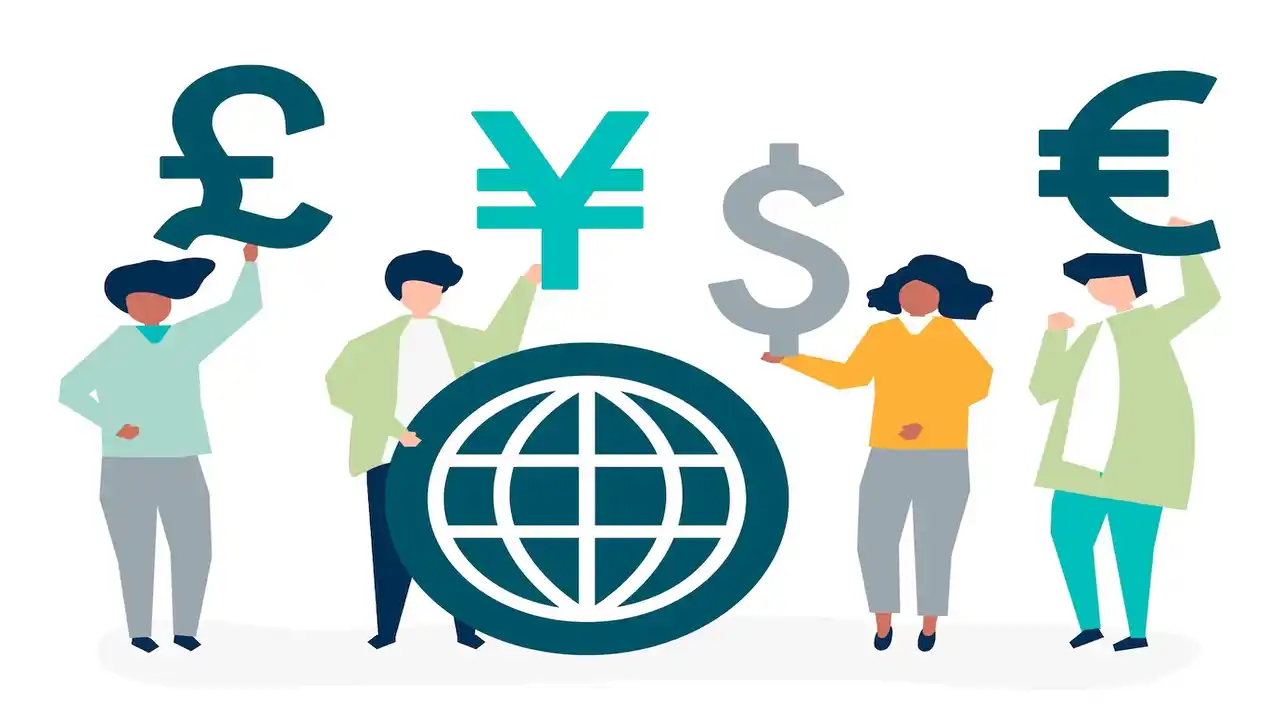
The most actively traded currency pairs are the “big crosses,” or EUR/USD, USD/JPY, GBP/USD, and USD/CHF. Keep in mind, especially if you’re just starting out in the FX market, that most currency transactions occur in these pairings. This, plus the fact that they are more liquid, could make it simpler to trade in these sets. Read on to learn more about characteristics of foreign exchange market and become the subject matter expert on it.
A trader’s preferred currency pair will vary depending on his or her risk tolerance and trading objectives. If you’re just getting started in the foreign exchange market, you might choose to focus on the more actively traded big currency pairs. Because of this, they become more fluid and potentially less unstable. If you’re curious about objectives of foreign exchange market, click here to read more.
Characteristics of Foreign Exchange Market
In order to conduct business within its borders, every nation issues its own currency. But what about business transactions in international markets? Currency regulations are a major barrier to international trade. The establishment of the Foreign Exchange Market enabled free currency exchange among individuals. The market determines the exchange rates of different currencies. We will go over the characteristics of foreign exchange market in detail in this article.
Over-the-counter (otc) Market
Transactions in the foreign exchange (FX) market, which operates in many different nations, take place off-exchange. Banks initiate transactions over the counter by telephone or telex since the market is mostly unregulated. There is no universally accepted code of conduct that dictates acceptable corporate behavior, and all financial institutions have explicit permission to buy and sell foreign currency. In addition, commercial banks and securities and trading organizations require no additional authorization to engage in international trade.
Superior Liquidity
The foreign currency market is larger and more liquid than other markets since it spans so many countries. The daily volume of business amounts to $5,100,000,000,000,000. Since currencies may be bought and sold at any moment, traders never have to fear losing money due to market fluctuations. There is always some sort of transaction taking place in the market. Buyers can now make as much money as they anticipated before entering the deal because of the increased liquidity. One of the characteristics of the foreign exchange market is its decentralized nature, operating 24 hours a day across different time zones.
The Dollar is the most Traded Currency
The US dollar is, by a large margin, the most frequently traded currency worldwide. In 1998, a survey estimated that daily global foreign exchange transactions amounted to $1.3 trillion, with the US dollar participating in about 87% of these transactions. The dollar’s wide usage is due to its significant involvement in various international contexts. It serves as an “investment” currency in multiple financial markets, a “reserve” currency held by numerous central banks, a “transaction” currency in international commodity markets, an “invoice” currency in contracts, and an “intervention” currency utilized by monetary authorities to manipulate exchange rates. The pivotal role of the dollar on the global stage contributes to its widespread adoption.
Additionally, the frequency with which the dollar is traded demonstrates its role as a “vehicle” currency in international transactions. This application benefits from and contributes to the dollar’s prominence in international trade and finance. In the vast majority of currency pairs, one currency is not traded directly against another. Instead, they trade one currency for the other against a third that they both use. Trading directly between the two currencies is uncommon. By the mid-1990s, the German mark had emerged as a serious contender, while the US dollar remained the most widely accepted form of car currency. This was because the 1980s and 1990s saw a dramatic increase in its use, particularly in Europe.
Excellent Market Transparency
For traders, greater “market transparency” implies more data about transactions is available directly from the market. The foreign exchange market is the most transparent marketplace since all participants can easily acquire the data they need to make informed trades. There is greater transparency because all transactions are recorded digitally and updated instantly. So now you can keep tabs on your portfolio as foreign exchange rates fluctuate in different nations.
Being Able to Go Long or Short
Short selling is a crucial aspect of FX trade, despite the fact that it is possible to “go short” in other markets through the use of derivatives such as contracts for difference (CFDs). This occurs because when exchanging currencies, market participants always sell one currency (the quotation currency) to purchase another (the base currency). A currency pair’s price is the equivalent in value, in the quote currency, of one unit of the base currency.
The pound sterling is the “base currency” and the “bid currency” in the GBP/EUR currency pair. At the current currency rate of 1.12156, one British pound is equivalent to 1.12156 Euros. You should buy the pair if you expect the pound’s value to increase relative to the euro. Another term for this is “going long.” You should sell the pound/euro pair if you anticipate a decline in the value of the pound/euro exchange rate. Sometimes this is referred to as “going short.” Whether you make or lose money depends on how well you predict the market, so you can prosper regardless of market conditions.
It’s a Market That’s Open 24 Hours a Day
Twenty-five years ago, the concept of a 24-hour market was only in its infancy. Even while there may be brief periods of slowness over the weekend, the world’s financial centers are open around the clock, every day of the week. The dollar and a variety of other currencies are routinely traded at banks and other monetary institutions. There is considerable overlap between the trading activity of the many financial hubs across the globe. As one facility closes for the day, another is opening its doors. Like the sun, the foreign currency market orbits the Earth.
Since the International Date Line is in the western Pacific, the business week in Wellington, New Zealand; Sydney, Australia; Tokyo, Hong Kong, and Singapore; and the rest of Asia and the rest of the world all begin one day earlier than each other. When markets in Bahrain and other Middle Eastern countries open for business, those Asian cities will still be open.
The European markets begin trading when it is already late in Tokyo. So, while it’s still early afternoon in Europe, trading begins in New York and other parts of the United States. The next day begins in the Asia-Pacific region when it is the middle of the afternoon in the United States. The markets have opened, and we must begin over.
Currency exchange rates and market circumstances are subject to fluctuation at any time because the market is open around the clock. These shifts could result from a change. Alterations are always a possibility. It also means that market participants have an obligation to be aware that a significant shift in an exchange rate may occur when enterprises in one region of the world are closed.
A Market with a Lot Going on
Due to the high volume of business conducted here, this marketplace is constantly one of the busiest in the world. The coin’s worth fluctuates both by the second and by the hour. There is constant activity in the foreign currency market around the clock. Investors in the foreign exchange market require accurate market data in order to make sense of the robust market trends now at play. So that companies can plan accordingly, predictions are produced concerning the future direction of currency market trends.
Less Expensive Trade
The foreign exchange market has a well-deserved reputation for cheap transactions. Each transaction incurs a nominal commission fee. Traders don’t have to pay hefty commission costs like investors do when buying other forms of investments. With just a few hundred dollars, or about $250, you can open a micro foreign exchange account and begin making investments. This paves the way for less well-off individuals to enter the trading market and yet generate respectable returns. Currency pair price changes account for all associated foreign exchange trade fees.
A Group of Sellers all over the World
The foreign exchange market is an international trading platform where buyers and sellers from all around the world come together. A middleman mediates transactions between buyers and sellers in this marketplace. Most dealers are large, internationally-recognized financial institutions like investment banks and commercial banks. Computers, cell phones, and other technological devices have allowed people from all over the world to stay in constant contact with one another.
Changes in the Forex
One reason currency prices fluctuate so rapidly is the sheer volume of daily currency transactions, which total billions of dollars per minute. Money can be made by taking a bet on whether prices will rise, fall, or remain stable. But volatility has both benefits and drawbacks. The market can turn against you at any time, therefore it’s crucial to employ risk management strategies to reduce your vulnerability.
Forex Market Hours
From Sunday at 9 p.m. (GMT) through Friday at 10 p.m. (GMT), the foreign exchange market is accessible around-the-clock, five days a week. These lengthy periods are necessary to complete the transactions because people transfer money directly to one another rather than using a centralized exchange. The foreign currency market is actually 24 hours a day, 7 days a week, allowing you to take advantage of fluctuations in trading activity at any time. Countries will move to daylight saving time on various dates throughout the months of March, April, October, and November. Because of this, the opening hours of the forex market will vary from day to day.
FAQ
What Kind of Market is the Market for Foreign Exchange?
The foreign exchange market is an OTC market where the exchange rates for various currencies are determined. It is the largest financial center on the planet. It consists of a worldwide web of financial centers that are accessible around the clock, every day of the week.
How do the Markets for Foreign Exchange Work?
Participants trade the currencies of various countries in the FX market, also known as the foreign exchange market, which operates globally. In terms of nominal value, the foreign exchange markets are the largest securities market in the world. Every day, participants exchange trillions of dollars on these marketplaces. In a foreign exchange market, participants compare and value currencies against one another using currency pairings.
People Want Foreign Exchange because
There exists a foreign exchange market whenever there is the possibility of speculating on the value of a currency other than one’s own. For the purpose of making a profit by selling at a later date, speculators will often purchase foreign currency at the current market price.
Final Words
An increase in capital account convertibility, or the ease of exchanging one currency for another, will accelerate the integration of Indian financial markets with international markets. However, if currency exchange was simplified in India, the country’s markets would be less vulnerable to global shocks like the current crisis in Southeast Asia. The banking sector and the economy stand to benefit from a smooth transition. We will go over the characteristics of foreign exchange market in detail in this article.